The mobile communications industry advertises rich downlink aggregation capabilities, underscoring the fact that uplink has no easy solutions – the upload speed is mostly limited by terminal power (0.2-0.4 W) resources, 100-200 times smaller than a typical base station power (40+ W).
Consequently, in remote locations the uplink throughput may be very low and is also subject to variations in environmental factors such as moving of air mass with different temperatures.
Instability is particularly critical for online conferencing or streaming apps like Zoom or Teams that typically use the UDP protocol.
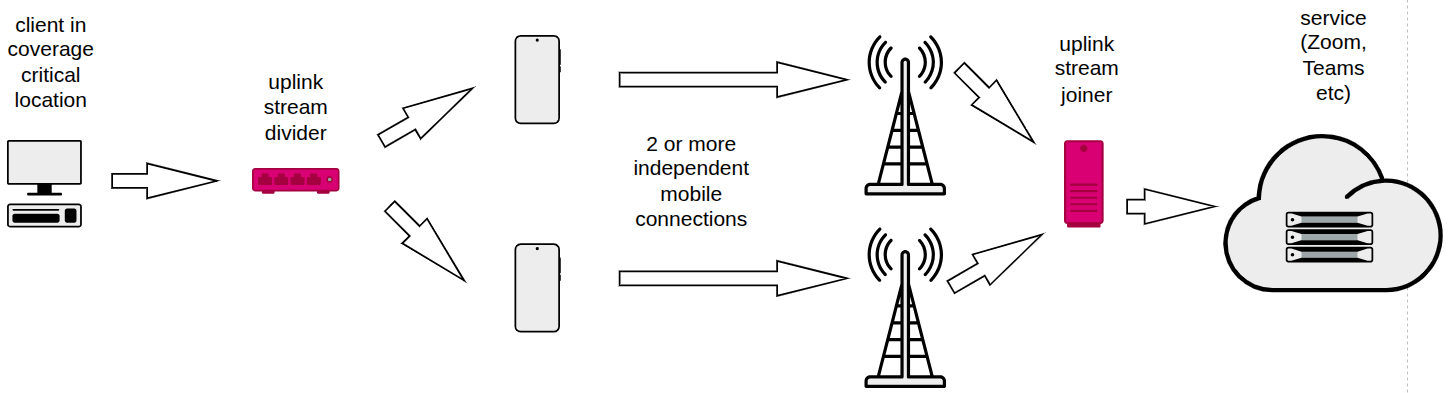
Because the value of the additional attenuation (fading) brought in by environmental variability is statistically subject to Rayleigh distribution, the upstream drops are typically much shorter than the periods of “normal” transmission, so for two independent connections (modems/routers oriented to different base stations) the dropouts will coincide with a low probability.
DuoRay proposes a two-end system with a flow divider/mirrorer at the client’s end and an aggregator on a fixed internet (or cloud) end that will significantly increase connection stability because of the independence of two (or more) mobile channels.
Coming soon.
maris.punenovs@startschool.org